Frame construction
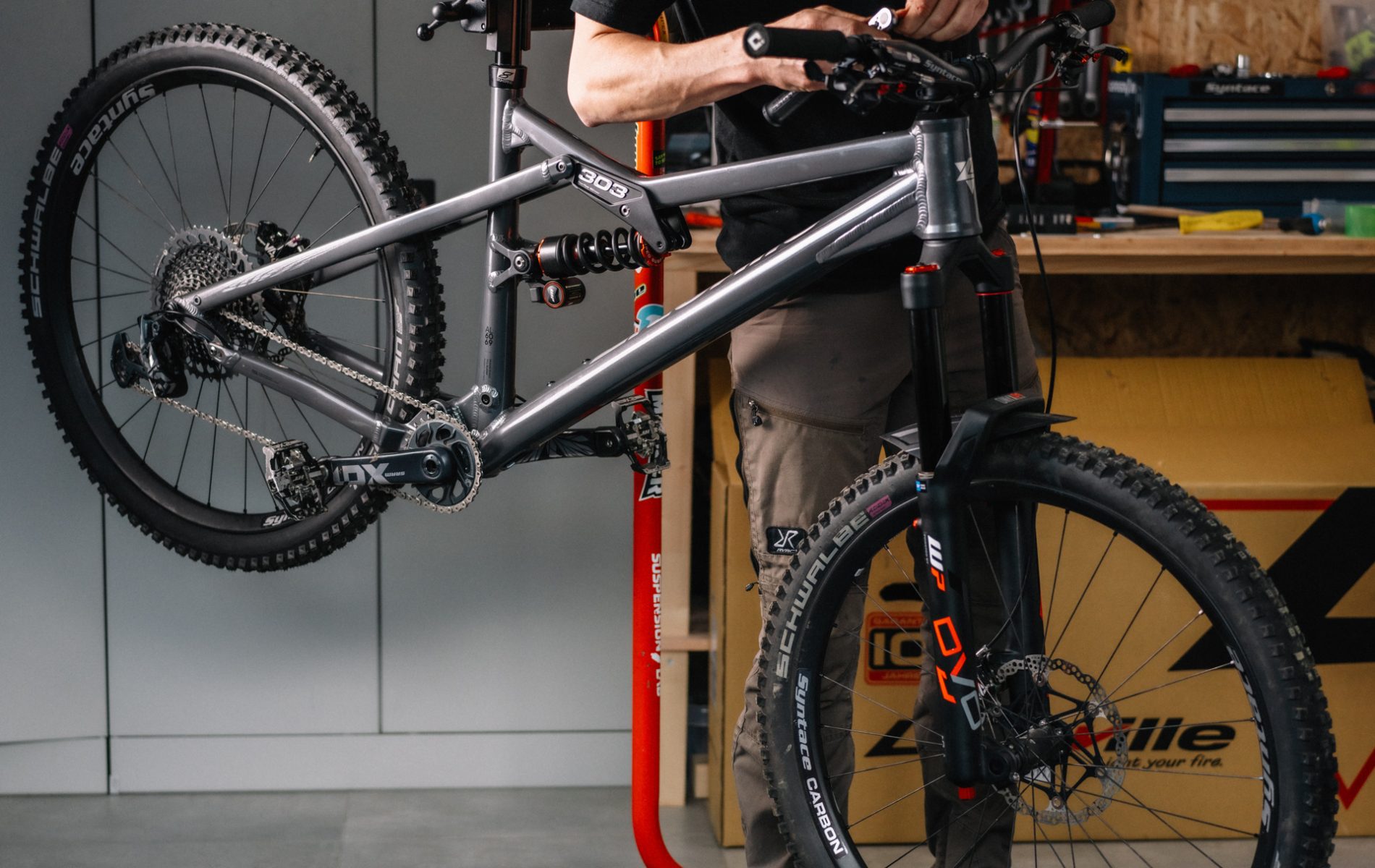
On first look the Liteville 301 frame does not look very much different from a conventional full-suspension MTB frame with the shock parallel to the top tube. The main difference is that the shock is not mounted, as usual, with the front to the frame but on the back side, to the connection of top tube and seat tube.
The decision to „reverse“ the shock mount has important reasons and is not just a design gag or just to do something different. It was our goal to design a real multi-pivot frame with a „healthy“ construction. That does mean that all forces are supposed to be introduced into the frame as easy as possible on frame and shock
A decisive advantage of the reverse shock linkage is the introduction of forces from the rear triangle and shock into the main frame triangle right to the very sturdy connection between seat tube and top tube. In addition, the introduced force is working against the force being exerted by the rider via seatpost and seat tube and is partially neutralized. In usual full-suspension frames with the shock parallel to the top tube, all forces are working in the same direction and stress the frame much more.
The frame
For maximum stiffness and durability we butted every single tube several times and created an oversize construction. The head tube, for example, is not, as it is customary, made for 1 1/8“ steerer tubes but for the new 1.5“ diameter. Because of the bigger diameter the wall thickness can be much thinner and the tube is actually lighter than most 1 1/8“ head tubes.
And since the head tube is so wide, the bottom tube with its 53mm diameter can be connected to it without ovalizing. In combination with the 44mm upper tube it creates a super stiffness, worthy of a freerider. The seat stays and chain stays are also butted differently to adjust for different loads. A special challenge was the bottom bracket area where bottom bracket, main pivot, front derailleur and rear tire are cramped in a small space. We emphasized efficient use of space to make room for the cranks and have loads of tire clearance at the same time.
Frame:
Diamond frame in oversize with 4-bar linkage diamond frame design,
up to 5-way butted tubes.
Material:
Custom made Aluminium with special heat treating.
Surface:
Shotpeened. Anodized with lasered logo.
Raceblack anodised, works finish or about 160 RAL colors with 650 color variations.
The rear triangle
One of our most important goals was to prevent the much-feared suspension bob because at the time of the start of this project, there were no “anti-bob shocks”.
Even today we maintain that it is possible to design suspension systems that are neutral to forces from pedaling and so not need SPV, ProPedal or else and are, at the same have a great small-bump sensitivity.
To design such a suspension we had to understand the reasons for bobbing. For one, the weight of the rider, for example while pedaling standing, causes it. To combat it one needs to have a smooth pedaling stroke – you either have it or need to practice it.
Another weighty factor is the chain torque, brought into the system by the rider.
Through optimum positioning of the 4 pivots of the rear triangle (of major importance is the position of the rocker link) the chain torque introduced into the system by the rider can be completely uncoupled from the function of the rear triangle – even under full load the rear will not bob, regardless of gear ratio.
And it is not necessary to use so-called “anti-bob” shocks. Actually, we noticed that most current shocks are not as well suited (because of too much damping) as “cheap” standard shocks.
It has to be added that the neutral suspension should cover as much of the shock stroke as possible for the rider to be able to pedal even across high obstacles. In our Liteville 301 the relatively long rocker link takes care of this.
Up to 2007 travel has been 115 mm, since model year 2007 the travel is 130 mm.
Travel
The effective frame travel with the DT Swiss SSD 212L Tuned is, depending on the levers used, 120, 140 or 160mm. The different levers are taking care of a perfect geometry adjustment and produce in tandem with the adequate suspension fork a perfect ride for all situations.
Pedal jack
Responsible for pedal jack is again the placement of the 4 pivots and the subsequent elongation of the chain when compressing. It is important that there is no pedal jack, regardless of gear. We eliminated pedal jack by precise placement of pivots.
Bearings
For all pivots we use only optimized bearings with special construction. The XC-Racing Kit (accessory) as well as the newest edition of pivot points do only have one bushing. There are 6 ball bearings (stainless, double sealed) in combination with one hermetically sealed (X-ring) special bushing in the upper tube.
This airtight bushing is being loaded by the patented 130 mm Liteville rocker link to achieve much improved suspension. All other pivot points use ball bearings.
Derailleur hanger
For a perfect function we designed the derailleur hanger as part of the frame. This way we achieve a much more precise shifting action compared to the usual, soft derailleur hangers. In all our time testing we never bent a derailleur hanger. In case it ever happens to you, we exchange the seat stays at cost.
The headset
If using 1 1/8" steerer tubes in the Liteville 301, you need to use a 1 1/8“ True Intergration headset. We recommend the use of the Syntace SuperSpin, equipped with double-sealed, stainless bearings. For replacement you can use all standard bearings for integrated headsets. The bearings of the Syntace SuperSpin are press-fitted into the bearing cups.
Cable routing
An important (and difficult) task has been the perfect routing of shift cables and brake hoses. We know from experience how important a dirt-proof routing with few and easy radiuses is. In dirty riding conditions the forces to operate shifters are getting higher fast, so we opted for a closed shifter housing all the way to the rear.
What is the weight of the Liteville 301 frame?
click pictures to enlarge
Frame without shock: To enable a comparison with our competitor´s weight specifications, who allways state the frame weight without a shock and mounting hardware.
Even in this weight a small Liteville-Secret is hidden:
As you can see above, a new Liteville 301 Mk8 frame weights (in size M) about 2320 grams net. The direct predecessor, the Mk7, was about 60g less, appr. 2260 grams.
No progress on first look, isn't it? In reality, though, a technical ruse is being used. The added 60 grams on the naked, non built-up frame are not really added weight but a clearly visible, functional improvement and a weight-saving investment:
Part of the 60 grams are several integrated elements and very solid direct mounts. On normal frames they have to be added afterwards - with more complicated , sometimes wobbly and always heavier add-ons.
The effective weight loss of a ready-to-go 301Mk8 bike through those integrated direct-mount interfaces add up to 100g on average - for the first time in their entirety realized on a mountain bike! And all of that with much better function in a more solid system.
Warranty:
On all mountain-bike frames delivered from 1. of September 2007, Liteville now gives 10 years (5+5) warranty on all material and manufacturing defects. A potentially necessary exchange for a new frame or frame component occurs free of charge within the first 5 years warranty period, in the 5 -10th year, a 50% discount on the respective current retail price is offered. For the installed rear shock, the warranty of the respective manufacturer is valid. For the Liteville 101 4X frame we give 3+7 years warranty.
Only condition: All components are to be installed and used as outlined in the owner’s manual.
In addition, Liteville will make a special offer to every Liteville-owner even for misuse or damage due to crash influences (“Bike on roof rack against garage wall”), direct through Liteville.
With Liteville products you are in good hands, even after you have bought the goods.