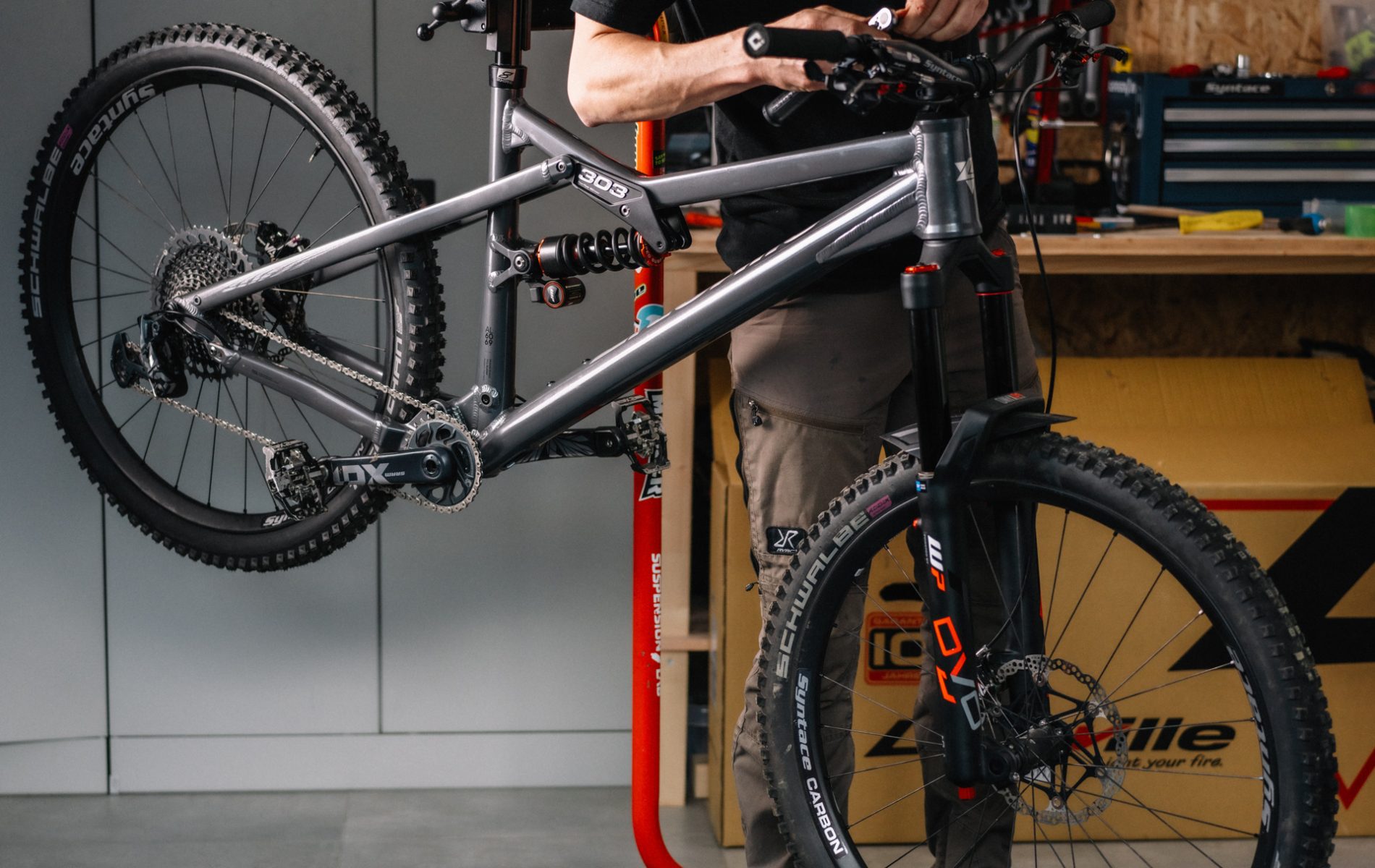
Why we are testing. And how we are testing
To create a functional and well-engineered frame from a good idea, you have to not only test a lot but also with forethought.
Tests with different riders and rider types are suited mainly to optimize geometry and chassis. Durability tests do not make sense with test riders – who wants to wait 2,3 or even 5 Years for results? That is why we test with machines, to achieve reliable results in as short a time as possible.
As well as in rider-based testing, mistakes can occur in lab tests. Therefore it is important to be diligent and self-critical. Also, it is of critical importance, not to blame possible bad test results on too hard or too unrealistic tests. If one is a responsible designer, you admit to bad results and try to use the gained knowledge to improve the product.
A test only carries value if it ca be repeated as many times as needed (and that it will be repeated!) to achieve results about improvements or deterioration as a result of product changes.
In actual riding tests we know the weight of the rider and maybe her riding style – everything else are variables that can not exactly be repeated.. Therefore such riding tests are not acceptable.
When using testing machines, not only is it important to put into the frame all existing forces but also to put them in at the correct angle – and no forces should be left out. All to get to realistic results.
For us, the most important question has been: do we design and build our own testing machine? Or do we rely on experience and equipment of a testing institute? Because of the extremely time consuming matter and the immense cost associated with it, we made the easy decision...
We had to find a testing institute with suitable testing machines according to our ideas – and we decided in favor of Velotech in Schweinfurt. In addition to service strength testing, Velotech can perform a variety of frame, rear wheel braking, front wheel braking and stiffness tests as well as jump simulations. To top it off, Velotech gained over the years considerable experience through accident evaluations.
The Test:
Finding the overall spring characteristic of frame and shock
The main frame will be clamped at the seat tube. With help of receivers at the drop-outs the shock will be compressed in small increments until it bottoms out. The respective shock travel and the necessary force will be recorded with calibrated gauges. Using the recorded data, a force/travel diagram can be made, the „spring characteristic“.
Test run of a prototype on the roller drum test rig
The test frame will be equipped with fork, handle bar, wheelset and seat post. Using springs, the frame is being fixed on the testing stand in a way that it is guided but not fixed in place. The weight of a rider (plus a generous safety margin) is now with the help of weights distributed on bar, seatpost and bottom bracket.
The testing run on the roller drum testing rig includes the ride over bars of different heights at different speeds. The wheels will be loaded asynchronous outside of the frequency range. The test will be run until a preset value has been reached or until frame failure occurs
Finding the „braking characteristic“ of the frame
The test is used to find out how the frame behaves at maximum brake forces. The introduction of force is into the fork drop-out exactly horizontal against driving direction.
Testing force:
max. 1000 N
(equivalent of slamming of the brakes (with 0.7 g) at 140kg gross weight (rider + bike + equipment))
Test rig for simulating pedaling standing and jumping
The test frame is being fixed at the fork and rear drop-outs. The rear triangle rests on a connecting link moveable to all sides.
During the test for pedaling standing the testing forces are being applied at the bar and at the extended BB axle.
For the jump test, a force of 3000 N is being applied several times at the extended BB axle
The testing forces
Step 1, 100.000 load cycles:
400 N arm pull and 1200 N BB stress
Step 2, 10.000 load cycles:
500 N arm pull and 1500 N BB stress
The frontal hit test
This test is necessary because significant strain is being put onto the front axle, for example while running over big bumps or if a frontal crash happens at medium to slow speeds. Those stresses are part of the normal spectrum of operation when using the frame.
The test is being run on a calibrated pendulum hit testing rig. The frame/fork unit will be clamped elastically at the BB and is being guided at the rear drop-out.. At the handle bar ends, the BB and at the center of gravity of the rider the frame is being loaded with a combined mass of 130kg. The mass is being braced against bar and seat post when force is being applied.
The hits of the pendulum are being directed against a solid roll fixed at the drop-outs. The energy of the hit starts at 60 Joule and is being increased by 60 Joule per hit up to 300 Joule.
Drawing on his experience as frame tester and evaluator, Velotech head Ernst Brust sees 300 Joule as a reference value that a bike frame has to withstand. BUT: many lightweight MTB and road frames can withstand only about 180 J to 240 J. Our first prototype gave in at 240 J and broke at the bottom tube. The current version of the Liteville 301 frame does withstand our minimum requirements without problems (with only 20g additional weight)
– 5x 300 Joule without damage!